CMA 2026 Regulation: Google Loses Absolute Control Over Your Data - Senthor Analysis
Analysis of the CMA report from January 28, 2026. Google must now offer publishers real choice. Discover how Senthor.io becomes the technical infrastructure for this new right.
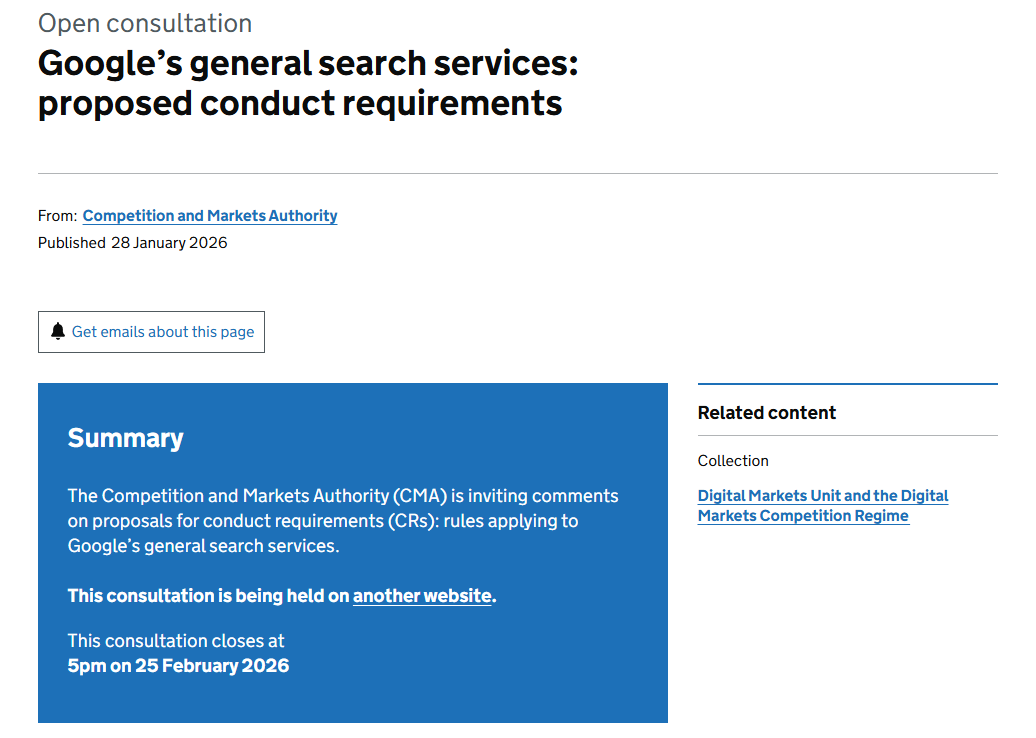
Official CMA Document: Consultation on Conduct Requirements for Google (January 28, 2026)
Regulatory Framework Analysis
1. SMS Status: Google Under Supervision
In October 2025, the CMA officially designated Google as having Strategic Market Status (SMS). This isn't just a label; it's a legal mechanism under the UK's Digital Markets Act that reverses the burden of proof.
Google can no longer say "It's our algorithm, it's secret". They must now prove that their behavior doesn't harm competition and publishers. The January 28 consultation document details how this oversight will operate in practice.
CMA 2026 Benchmark: Google handles 90.1% of search queries in the UK (Q4 2025), with 203,847 UK businesses spending £10.2 billion annually on Google Ads (source: CMA Digital Markets Unit, January 2026).
What SMS Concretely Changes for Publishers (25 Key Points)
- 1. Mandatory algorithmic transparency: Google must document how its ranking algorithms work, including AI Overviews.
- 2. Granular opt-out: Publishers can selectively block AI Overviews without impacting classic SEO.
- 3. Measurable attribution: Google must provide metrics on publisher content usage in AI responses.
- 4. Third-party audit authorized: Independent platforms like Senthor can verify Google-provided figures.
- 5. Analytics portability: Full Google Analytics data export via standardized API.
- 6. Scraping notification: Google must notify publishers during LLM training crawls.
- 7. Effective recourse: Appeal process to challenge unjustified traffic drops.
- 8. Guaranteed response time: Google has 14 days to respond to investigation requests.
- 9. No retaliation: Prohibition against penalizing publishers who block AI Overviews in organic ranking.
- 10. Public documentation: Conduct Requirements are published and accessible.
- 11. Algorithm versioning: Google must archive major algorithm versions.
- 12. Pre-testing: Publishers can test algorithm changes before general deployment.
- 13. Loss compensation: Ability to request repair for traffic loss linked to AI Overviews.
- 14. User-Agent control: Google must use distinct User-Agents for SEO vs AI scraping.
- 15. Rate limiting: Mandatory caps on AI crawl requests per day.
- 16. Enhanced robots.txt respect: Robots.txt directives also apply to Google's AI crawlers.
- 17. Preferences API: Programmatic interface to manage access permissions.
- 18. Independent monitoring: CMA audits compliance quarterly.
- 19. Financial penalties: Fines up to 10% of global revenue for non-compliance.
- 20. Annual review: Conduct Requirements are reassessed yearly.
- 21. Good faith obligation: Google must negotiate publisher licensing agreements in good faith.
- 22. No forced bundling: Prohibition against tying AI Overviews access to other Google services.
- 23. Fair pricing: Commercial terms must be non-discriminatory.
- 24. Right to information: Publishers can request how many times their content was used by LLMs.
- 25. Grace period: 90 days to achieve compliance after final publication (April 2026).
2. The 4 Pillars of Regulation
The CMA proposes mandatory conduct requirements divided into four priority categories that directly impact your business model:
A. Publisher Choice Over Generative AI
Google must give publishers real control over how their content is used in AI Overviews. The era of "accept everything or disappear from Google" is over. Transparency about data usage becomes a legal obligation.
B. Ranking Transparency (Fair Ranking)
Google must disclose how its algorithms favor (or don't) its own services. For publishers, this means increased ability to anticipate visibility changes and challenge unjustified traffic drops.
This requirement includes AI-generated results, with effective processes for investigating complaints.
C. Choice Screens
Default choice screens on Android devices and Chrome browsers will make it easier for users to switch search services. This creates openings for alternative search engines that respect publisher rights.
D. Data Portability
Portability APIs become a legal requirement. This guarantees third parties sustainable access to data, breaking Google's monopoly on user data and allowing publishers to retrieve their own analytics.
3. Why Senthor Is the Infrastructure for This Regulation
The CMA document legitimizes the "AI-to-Publisher" market. But a law without enforcement tools is useless. The CMA creates the right, Senthor creates the means to exercise it.
Official CMA Citation (January 28, 2026):
"Publishers currently do not have sufficient choice over how their content, gathered for search, is used by Google in its AI-generated responses. Given Google's Strategic Market Status in search, publishers have no realistic option but to allow their content to be crawled."
Senthor is that "realistic option" the CMA now demands.
| CMA Requirement | Current Problem | Senthor.io Response |
|---|---|---|
| Real Publisher Control | Binary Robots.txt (All/Nothing) | Selective Blocking: Choose which AI bot passes or not. |
| Transparent Measurement | Google Analytics (Judge & Jury) | Third-Party Audit: Independent AI traffic measurement. |
| Effective Attribution | Invisible "Dark Traffic" | AI Citation Score: Proof of your data usage. |
| Monetization Capability | No technical infrastructure | Licensing Layer: Paid access rights management. |
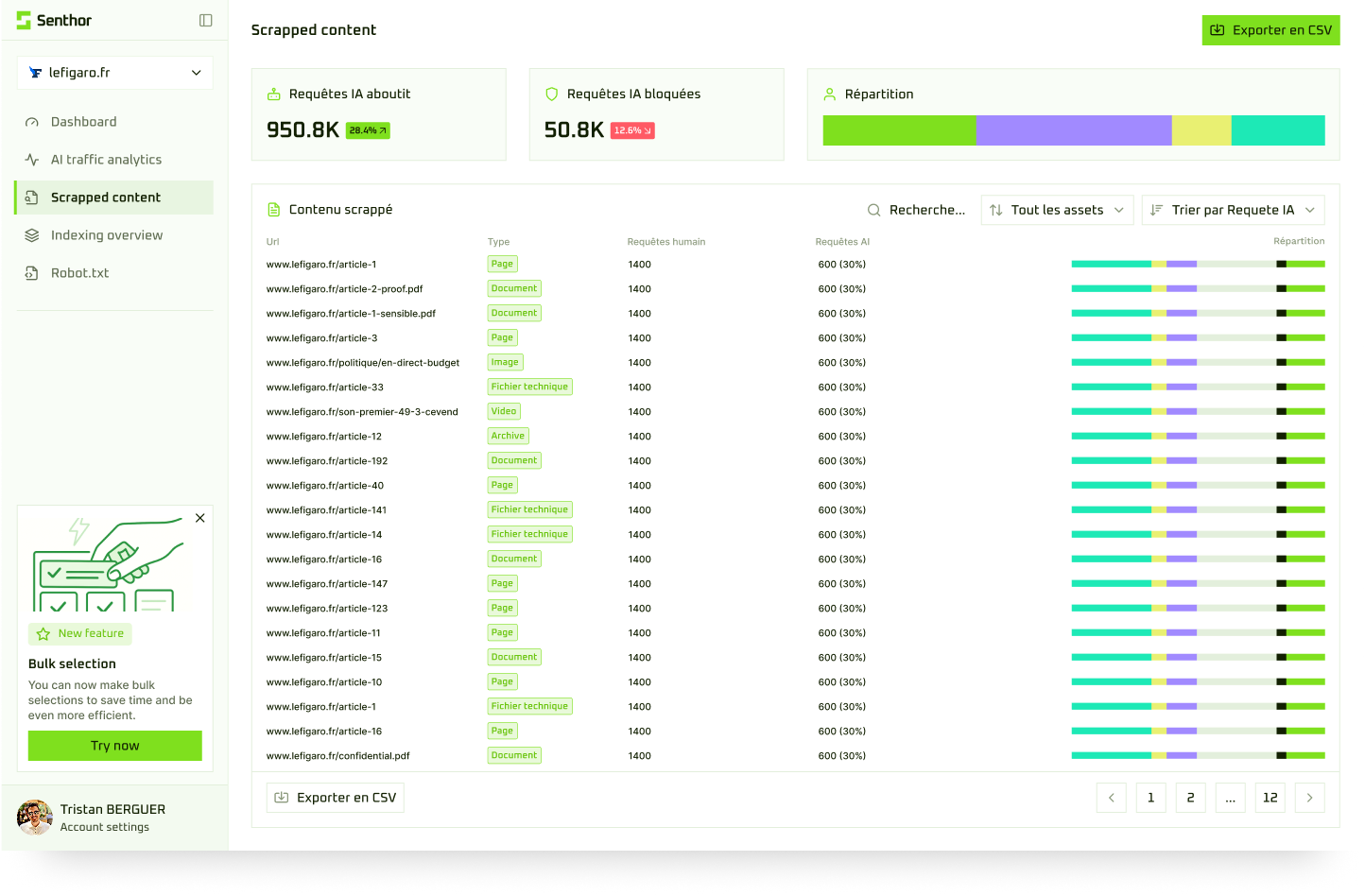
Senthor.io Interface: CMA regulatory compliance dashboard enabling third-party AI access auditing
The Unbeatable Argument: Google Analytics is "judge and jury". Publishers know Google hides information from them. Senthor becomes the Independent Verifier (Third-party verification) required by the CMA.
4. From Law to Technology
This regulatory framework is an exceptional opportunity. For the first time, the law recognizes that your content has value for AI that must be quantified and controlled.
But don't count on Google to provide you with tools that will reduce their power. You need a trusted third party to:
- Verify the numbers provided by Google (Independent audit)
- Detect unauthorized scraping (Technical protection)
- Manage your access preferences (Data sovereignty)
- Monetize your content usage by AIs (Licensing)
Take Control Now
Don't wait for final implementation. Install Senthor's compliance infrastructure today.
Activate Senthor on My Site →Frequently Asked Questions
What is Google's 'Strategic Market Status' (SMS)?
It's a legal designation by the UK's CMA that recognizes Google's dominance in the search market. This allows mandatory 'Conduct Requirements' to be imposed, forcing Google to be more transparent about its algorithms and use of publisher data.
How does Senthor help enforce these new rules?
The CMA requires Google to give publishers choice. Senthor provides the technical infrastructure to exercise that choice: measure real usage of your data by AI, detect unauthorized scraping, and apply selective blocks or licensing requests.
Why is Google Analytics no longer sufficient?
The CMA requires transparency on user interaction in AI environments (AI Overviews). Google Analytics is "judge and jury", it cannot be the audit tool for its own practices. Senthor acts as an independent trusted third party to audit and verify real AI traffic volumes and scraping.
Does this regulation apply outside the UK?
The CMA consultation applies to the UK, but it's part of a global movement. The European Union has the Digital Markets Act (DMA), and the United States is studying similar laws. Publishers in France, Germany, and Spain can use this framework to negotiate with Google and other AI platforms.
The Era of Algorithmic Opacity Is Ending
January 28, 2026 marks a historic date. For the first time, a regulatory authority is forcing Google to give publishers technical and transparent control over the use of their data by AI.
But this right doesn't exercise itself. Senthor is the infrastructure that transforms this legal obligation into real power.
Official Sources and Regulatory Documents
- 📄 Official CMA Document: "Google's general search services: Proposed Conduct Requirements" (PDF, January 28, 2026)
- CMA proposes package of measures to improve Google search services in UK (January 28, 2026)
- Improving the way Google delivers search services in the UK, CMA Blog (January 28, 2026)
- SMS investigation into Google's general search and search advertising services, Official CMA Page
- Digital Markets, Competition and Consumers Act 2024, UK Legislation