Paying the sources AI cites: uwait and the emerging wave funding the web
AI cites millions of sources without ever paying them. A new generation of initiatives wants to fix that. A look at uwait, which pays 30% of its revenue to the sources cited in AI answers, and at the broader movement taking shape.
Contents
1. AI cites, but does not pay: the broken economy of the citation
For twenty years, the web ran on an implicit contract. A search engine indexed your content, and in exchange it sent you traffic. You turned that traffic into revenue: ads, subscriptions, sales. The citation was worth a click, and the click was worth money.
AI answer engines broke that contract. When a user asks ChatGPT, Perplexity, or Gemini a question, the AI reads your articles, extracts the substance, and answers directly. The answer is complete. The user no longer needs to click. Your content was used, your source may even have been cited, but no traffic and no revenue came back to you.
The imbalance in one sentence: usage of your content explodes while referral traffic collapses. The source that produces the information ends up outside the economic loop it actually feeds.
This is not a theoretical problem. It is already measurable, as long as you look in the right place. AI bot traffic is invisible in Google Analytics, which relies on JavaScript that most AI crawlers do not execute. To see it, you have to measure at the server level. We break this down in our article on the AI traffic Google Analytics cannot see.
2. The new wave: how AI can pay the sources it cites
The good news is that the topic is now on the table, and several concrete models are emerging to move value toward sources. None is the standard yet, but together they sketch a citation economy being built in real time.
Direct licensing deals
The major AI providers sign licensing deals with large publishers to use their content. It works, but it is reserved for a handful of players with the leverage to negotiate. The French press is organizing a collective response, which we analyze in our article on the press alliance facing AI licensing.
Revenue-share programs
Some answer engines, Perplexity in the lead, have launched programs that share part of their revenue with the publishers whose content is cited. The idea looks like an affiliate model applied to the citation.
Pay-per-crawl
Infrastructure players such as Cloudflare have introduced pay-per-crawl: charging for access to content at the moment a bot fetches it. It is the logic of a toll rather than a wall. The x402 protocol pushes this idea even further by turning every HTTP request into a payment opportunity, as we explain in our article on the x402 protocol.
Citation-based revenue attribution
A more granular approach measures which sources actually contributed to an AI answer, and distributes compensation based on that contribution. Several young companies are building this attribution model.
New-generation ad networks
And then there is an approach coming from advertising, which funds the ecosystem through an entirely new channel rather than through negotiation. That is exactly the bet uwait is making.
3. uwait: "Get paid while AI thinks"
uwait starts from a simple observation. When you ask an AI a question, there is dead time: those few seconds while the model thinks and generates its answer. That waiting time has no value today. uwait proposes to turn it into value, and to redistribute it.
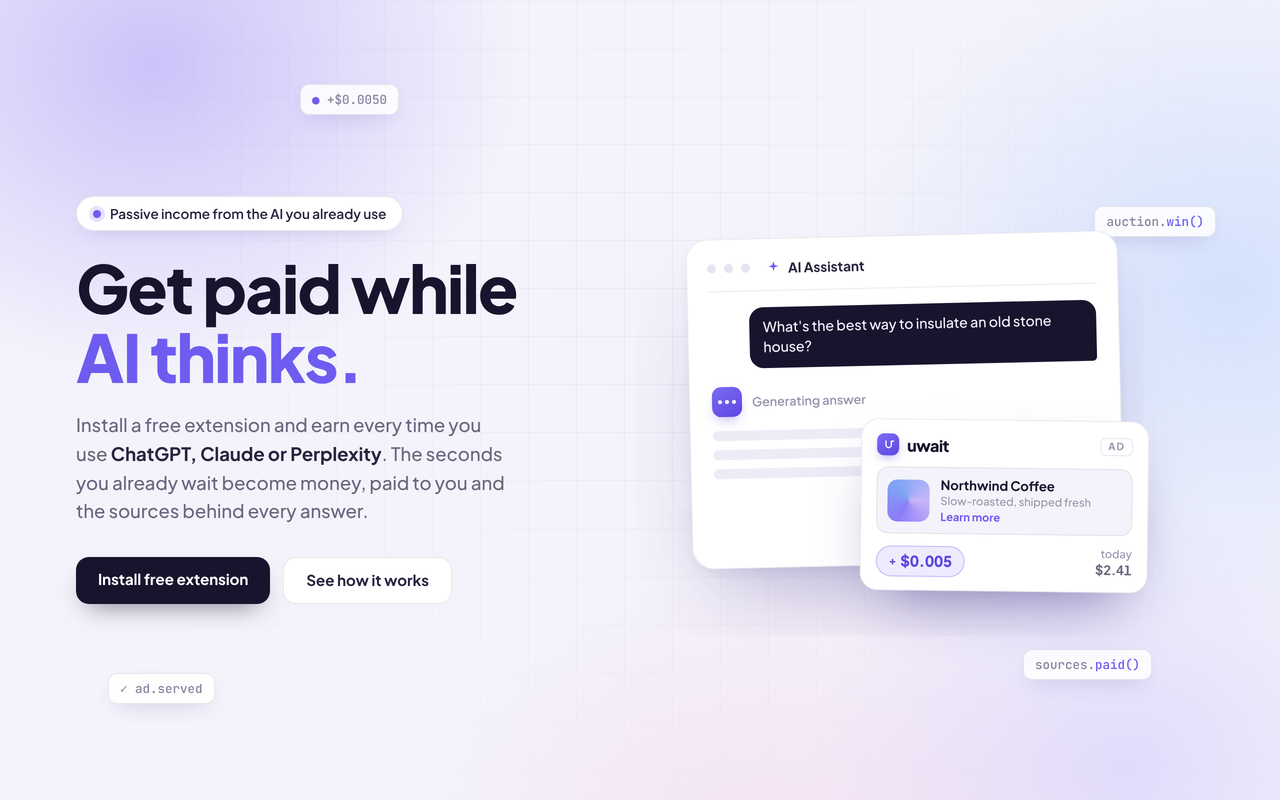
How it works
- The user asks a question to their AI assistant (ChatGPT, Claude, Perplexity, Gemini, Mistral, Copilot, DeepSeek, Grok) through a browser extension.
- A real-time auction fires while the AI generates its answer.
- A native ad appears discreetly, below the answer, without interrupting the experience.
- The user is paid immediately for their attention.
- The revenue is split across all stakeholders.
The uwait revenue split
- 50%to the user who lends their attention
- 30%to the sources cited in the AI answer
- 20%to the platform
The detail that matters here is those 30% paid to cited sources. For the first time, simply being cited in an AI answer triggers a flow of revenue toward the publisher, without any negotiation required. The citation becomes monetizable again, through an unexpected path: advertising on the user side rather than traffic on the publisher side.
Transparency: uwait was launched by Senthor's founder. Both projects share the same conviction: in the generative AI era, the sources that produce information must be paid. uwait works on the demand side, Senthor on the publisher side.
4. Why paying 30% to sources changes the game
Most source-compensation models rest on leverage. To sign a license, you need a catalog big enough to interest an AI provider. To negotiate, you need a brand strong enough to matter. The result: very large publishers capture value, and the rest of the web is left behind.
The appeal of a model like uwait's is that it depends on no negotiation. If your content is cited in an answer, you are eligible for your share. The small publisher, the niche blog, the specialized outlet enter the same loop as the giants. It is an ecosystem logic rather than a power game.
| Model | Open to small publishers? | Negotiation required? | Who pays |
|---|---|---|---|
| Direct license | No | Yes | The AI provider |
| Revenue share | Program-dependent | Sign-up | The answer engine |
| Pay-per-crawl | Yes | No | The crawling bot |
| Ad network (uwait) | Yes | No | The advertiser |
None of these models will win alone. The citation economy will probably be a stack: a license for large catalogs, a toll for crawlers, a revenue share for visibility, and an advertising channel to fund mainstream usage. What matters is that every publisher can plug into these flows as they come online.
5. Where Senthor fits in this economy
All these models share one prerequisite that often goes unsaid: you first have to know that AI is using your content. You cannot monetize, negotiate, or regulate traffic you cannot see. And that traffic is precisely invisible in standard tools.
That is Senthor's role. Installed at the server level or on the edge, Senthor intercepts every request before it reaches your application, and identifies AI bots even when they pretend to be regular browsers. You then get three things:
Measure
A real-time dashboard of AI traffic on your site: which bots, which pages, what volume. The mandatory starting point of any strategy.
Control
One decision per bot: allow, monetize, or block. Instead of a blanket block that destroys your visibility in AI answers, you keep control bot by bot.
Monetize
Turn AI access into revenue, through the emerging payment mechanisms, without sacrificing your presence in generative engines.
The complementarity: uwait creates a channel that funds sources on the demand side. Senthor gives you visibility and control on the publisher side. One does not replace the other. Together, they sketch a web where being cited by AI becomes an asset again, not a leak.
If you run a site and want to know where you stand, start with the simplest step: measure. You can estimate what your AI traffic represents with our revenue estimator, or learn how to monetize bot traffic instead of blocking it.
Take back control of your content in the AI era
The citation economy is being built right now. The first step is free: measure the real AI traffic on your site with Senthor, then decide what to do with it.
FAQ: paying the sources AI cites
What is uwait?
uwait is an ad network built for AI chat interfaces. It shows a native ad while the AI generates its answer, then splits the revenue: 50% to the user, 30% to the sources cited in the answer, and 20% to the platform. Its tagline sums up the idea: "Get paid while AI thinks."
How can AI pay the sources it cites?
Several models are emerging in 2026: direct licensing deals, revenue-share programs, pay-per-crawl tolling, citation-based revenue attribution, and ad networks like uwait that pay a share to cited sources. The common thread is moving value toward sources rather than leaving them out of the loop.
Why is this topic emerging now?
Because AI answer engines respond to users directly from publisher content, without producing the click that funded that content. Referral traffic collapses while usage explodes. Without a new compensation mechanism, the source that produces the information loses its business model.
What is the link between uwait and Senthor?
Both projects share the same conviction: the sources AI cites must be paid. uwait works on the demand side, creating an advertising channel that funds sources. Senthor works on the publisher side, detecting AI traffic on your site and letting you control and monetize it. uwait was launched by Senthor's founder.
How can a publisher prepare?
First, measure the real AI traffic on your site, invisible in Google Analytics. Then decide on a per-bot strategy (allow, monetize, or block) rather than a blanket block that destroys GEO visibility. Finally, position yourself on the emerging compensation mechanisms. Senthor covers measurement, control, and monetization.
Further reading
- Bot traffic monetization: stop blocking AI, make it pay
- The x402 protocol: machine-to-machine payments for your content
- The press alliance and AI licensing: the collective response
- Google Analytics vs Senthor: the invisible AI traffic
Share this article